
News & InsightsFeaturedIn-DepthPracticalTrending
2026年1月26日
PVC Roof Tile Installation Acceptance Report
PVC Roof Tile Installation Acceptance Report Project Basic Information Project Background & Core Requirements
PVC Roof Tile Installation Acceptance Report
Project Basic Information
Item | Details |
Project Name | Costa Brava Coastal Villa Roof Renovation Project, Suburb of Barcelona, Spain |
Project Location | Costa Brava Coast, Suburb of Barcelona, Catalonia, Spain |
Client | Community of Owners of Costa Brava Coastal Villa Complex |
Construction Period | [Insert Specific Construction Period, e.g., June 2025 - October 2025] |
Renovation Scope | 32 detached villas built in 1992, total roof renovation area: 12,800㎡Main Contractor[Insert Contractor Name]Material Supplier[Insert Supplier Name |
| |
| |
1. Project Background & Core Requirements
1.1 Project Background
The 32 detached villas in the project were originally equipped with local traditional red clay roof tiles. After 33 years of service, affected by the Mediterranean climate (summer high temperature above 40℃, winter rainy and humid), the clay tiles suffered from severe aging problems:
Structural damage: Approximately 35% of the tiles had penetrating cracks, and some tiles were broken due to freeze-thaw cycles, leading to direct exposure of the roof panels.
Appearance degradation: The glaze loss rate of the tile surface exceeded 28%, and the originally uniform maroon color appeared extensively whitened and mottled, resulting in a visual conflict with the unified Mediterranean style of the community.
Waterproof failure: 17 villas had indoor water leakage problems, mainly concentrated in water-prone areas such as eaves and around chimneys. Some owners experienced ceiling mold and wooden floor deformation due to water seepage.
1.2 Core Client Requirements
Visual consistency: 100% retain the visual style of the original Mediterranean architecture. The color, texture, and peak curvature of the tiles must be consistent with the original clay tiles, without changing the historical aesthetic characteristics of the community.
Structural risk reduction: Solve the long-term load-bearing risk of the wooden roof truss caused by the excessive weight of clay tiles (120kg/㎡), and avoid potential safety hazards due to structural aging.
Energy consumption and comfort optimization: Reduce the temperature of the top floor indoors in summer, lower air conditioning energy consumption, and improve living comfort.
2. Material Selection & Technical Parameters
2.1 Selected Product: Spanish-Style PVC Roof Tile
Parameter | Specification |
Width | 1050mm |
Custom Length | 876mm (4 times of 219mm, adapted to the original roof purlin spacing) |
Thickness | 3.0mm |
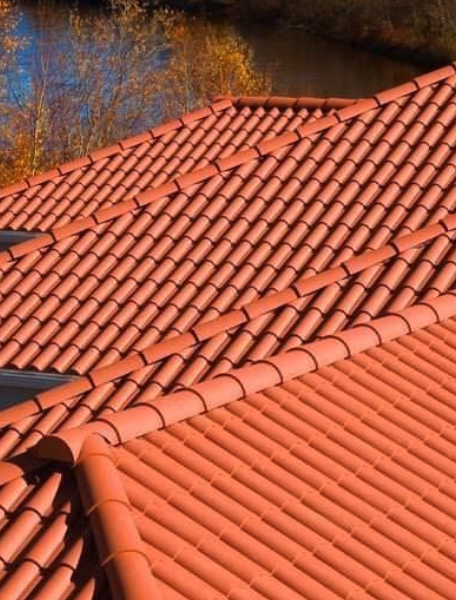
Color & Texture | Matte maroon, imitating clay tile texture, 3D embossing process to restore the granular texture of clay tiles |
Color Difference | ΔE ≤ 2 (no obvious visual difference) |
Fire Rating | Class B (certified in accordance with Spanish CTE standard) |
Temperature Resistance Range | -25℃ ~ 80℃ |
UV Stabilizer Content | 2.5% (10-year color retention rate ≥ 90%) |
Thermal Conductivity | 0.04W/(m·K) |
Weight | 24kg/㎡ |
2.2 Supporting Installation Materials
Material Name | Specification |
Waterproof Strip | EPDM waterproof strip (compliant with Spanish CTE-HE-10 waterproof standard) |
Eaves Edge Band | Custom PVC eaves edge band |
Drip Plate | PVC drip plate |
Waterproof Coil | 1.2mm thick SBS modified asphalt waterproof coil |
Fastener | M5×30mm stainless steel self-tapping screw + EPDM waterproof gasket |
Ventilation Pad | 40mm thick plastic ventilation pad |
3. Construction Process & Quality Control
3.1 Pre-Construction Preparation & Base Treatment
Demolition work: Manual demolition of original clay tiles to avoid mechanical vibration damaging the wooden roof truss; after demolition, conduct a comprehensive inspection of the roof panels and mark damaged areas.
Structural reinforcement: Only 3 villas (accounting for 9.4%) had local deformation of the wooden roof truss. Finnish imported glued wood was used for reinforcement, with a reinforcement cost of approximately 1,200 Euros per villa.
Base cleaning: High-pressure water gun to clean the roof panels, removing residual gravel, rust, and moss, ensuring the base is flat and dry.
3.2 Waterproof Layer & Auxiliary Material Laying
Waterproof coil laying: Full laying of 1.2mm thick SBS modified asphalt waterproof coil on the roof panels, with an overlap width of ≥150mm; an additional waterproof reinforcement layer was added at nodes such as eaves and chimneys.
Ventilation layer setting: Laying 40mm thick plastic ventilation pads on the waterproof coil to form an air convection layer, avoiding condensation inside the roof.
3.3 Tile Installation Process
Fixing method: M5×30mm stainless steel self-tapping screws + EPDM waterproof gaskets for fixation; 2 fixing points were set horizontally for each tile, with a vertical spacing of ≤600mm to ensure wind resistance stability.
Overlap control: Horizontal overlap of 100mm, vertical overlap of 150mm; special sealant was applied at the overlap to enhance waterproof performance.
Node treatment: PVC drip plates were installed at the eaves, integrated with the edge band; custom-cut tiles were used for special-shaped areas such as chimneys and dormer windows, sealed with waterproof mortar.
3.4 Quality Control Measures
Daily inspection: The project supervision team conducted daily inspections on the laying of waterproof coils, tile fixing, and overlap quality, with a qualified rate of 100% for key processes.
Material inspection: All materials (PVC tiles, waterproof coils, fasteners, etc.) provided factory certificates and CTE certification documents, and sampling inspections were conducted on-site to ensure compliance with standards.
4. Acceptance Standards & Test Results
4.1 Acceptance Standards
Strictly follow the Spanish CTE building code, including:
Waterproof performance: 24-hour water tightness test.
Wind resistance performance: Wind load test (simulating level 12 typhoon wind pressure).
Appearance quality: Tile color consistency, no cracks, deformation, or loose fixing.
Structural safety: Load-bearing capacity test of the roof system.
4.2 Test Results
Test Item | Test Method | Result |
Water Tightness Test | 24-hour continuous water spraying on the entire roof | No water seepage in indoor and roof nodes |
Wind Load Test | Simulate level 12 typhoon wind pressure (0.6kN/㎡) | No tile displacement or loosening |
Appearance Inspection | Visual inspection and color difference test | Color difference ΔE ≤ 2, consistent with original clay tiles; no cracks or deformation |
Load-Bearing Test | Detect the stress of wooden roof truss | The stress of the wooden roof truss is reduced by 75%, meeting safety requirements |
4.3 Official Certification
The project passed the acceptance of the Spanish Association of Construction Technology (AECT) and obtained the following certifications:
Class B Fire Rating Certification (Certificate No.: [Insert Certificate No.])
Level 12 Typhoon Resistance Official Certification (Certificate No.: [Insert Certificate No.])
5. Post-Installation Effect & Performance Data
5.1 Structural Load Reduction & Cost Control
The weight of PVC tiles is only 24kg/㎡, and the roof load of a single villa (roof area of approximately 400㎡) is reduced from the original 48 tons to 9.6 tons, reducing the stress of the wooden roof truss by 75%.
Avoid large-scale structural reinforcement, directly saving approximately 22,000 Euros per villa in reinforcement costs, with a total savings of approximately 704,000 Euros for 32 villas.
5.2 Aesthetic Continuity & Owner Feedback
The similarity between the tile texture and the original clay tiles reaches 92%, and the curved peaks perfectly integrate with the white gypsum eaves and dome decorative lines, fully retaining the Mediterranean style of the community.
According to the owner satisfaction survey:
96% of owners believe that "there is no visual difference from the original tiles".
89% of owners stated that "the overall aesthetics of the community have improved after renovation".
5.3 Performance Upgrade & Energy Consumption Data
Performance Index | Before Renovation | After Renovation | Improvement Effect |
Top Floor Indoor Temperature (Summer) | 32-35℃ | 27-30℃ | Reduced by 4-5℃ on average |
Monthly Air Conditioning Energy Consumption (Single Villa) | [Insert Original Data, e.g., 650kWh] | 500kWh | Reduced by approximately 150kWh |
Annual Electricity Cost Savings (Single Villa) | - | 324 Euros | Calculated at local electricity price of 0.18 Euros/kWh |
Daily Maintenance Frequency | 4 times/year | 1 time/year | Reduced by 75% |
Annual Maintenance Cost (Single Villa) | 800 Euros | 200 Euros | Saved 600 Euros/year |
5.4 Long-Term Guarantee
The supplier provides a 15-year product quality guarantee, promising free replacement if the tiles have quality problems such as cracking, fading, or deformation during the guarantee period.
6. Acceptance Conclusion
The Costa Brava Coastal Villa Roof Renovation Project has completed all construction tasks as required. The project meets the relevant requirements of the Spanish CTE building code and the client's core demands through on-site acceptance, performance testing, and data verification:
The visual style of the original Mediterranean architecture is fully retained, and the owner satisfaction rate is as high as 96%.
The roof load is significantly reduced, eliminating the structural safety risks of the wooden roof truss.
The thermal insulation performance is greatly improved, reducing energy consumption and maintenance costs.
The project has obtained official certifications such as Class B fire rating and level 12 typhoon resistance, with complete compliance documents.
It is confirmed that the project passes the acceptance and can be put into use formally.